
individual record


id | first | middle | last | dob | dod | cod |
| 100 | Fletcher | B. | Hulet | 4/7/1803 | 11/5/1882 | old age and general infirmity |
veteran | exhumed | purchaser | cemetery |
| FALSE | Adams Street |
lot | plot | ||||||
| R8 G18 in Hulet family lot |
relations |
| Frances "Fanny" Granger (1st wife, b. 15 June 1803, d. 2 January 1865) Martha Hulet Lyon (daughter, b. c 1830) Margaret Eunice Hulet Chappel (daughter, b. c 1832, d. 20 Sep 1856) Clara "Clarissa" Somers Hulet Wheeler (daughter, b. c 1834) Gilbert Mather Hulet (son, b. c 1836, d. 6 Nov 1854) Harriet G. Hulet Walker (daughter, b. c 1841, d. 28 July 1928) Marshall Fletcher Hulet (son, b. c 1846) Lois Case (2nd wife, b. c1808, no children) Thomas B. Walker (son in law, married to Harriet) Charles Lyon (son in law, married to Martha, 1828-4 Apr 1869) Margaret C. Lyon (granddaughter, 5 Feb 1854-28 Jul 1855) six other Lyon grandchildren W. H. Chappel (son in law, married to Margaret E., died fighting on Confederate side in the Civil War) Rowland G. Chappel (grandson, 30 Jun 1852-28 Jul 1854) Caroline "Carrie" Hunt Hulet (daughter in law, married to Marshall Fletcher Hulet, 2 Oct 1848-8 Oct 1868) Rev. John Wheeler (son in law, married to Clara) Mariah Wheeler (granddaughter?, born c. 1841 to Mrs. D. [J.?] Wheeler) John Wheeler (grandson, b. 1865, d. 8 Sept 1865) Mary Agnes Wheeler (granddaughter, b. c1851, d. 9 Aug 1864) five other Wheeler grandchildren Capt. John Hulet, Sr. (father, b. 20 Mar 1756--served in Revolutionary War, 1777-1781) Hannah Walker Hulet (mother, father's 2nd wife) Sally Howe Hulet (father's 1st wife, mother of Achsa, Betsey, Wesley, and John Jr.) John Hulet (paternal grandfather) Ascha Hulet Chapin (half-sister) Wesley Hulet (half-brother) Betsey Hulet Foster (half-sister, married to Nathan Foster, in Berea) John Hulet Jr. (half-brother, d. in Abbeyville, OH) Isaac Hulet (brother) Abijah Hulet (brother) Mrs. J. T. Porter (sister, lived in IL) Samuel Hulet (brother, of Berea, d. in IL) Sally Hulet Curtis (sister, b. 1 Jan 1800) Chauncey Hulet (nephew, son of John Jr, b. 1840) Sarah Hunt Hulet (married to Chauncey) Jonathan Turner Hulet (nephew, b. 16 August 1823, d. 9 September 1901) Catherine Bishop Hulet (J.T. Hulet's first wife, c. 1826-1875) Mary E. Foster Clark Hulet (J.T. Hulet's second wife, 1 Sep 1835-29 Jun 1901) Wesley Edwin Hulet (grand nephew born to JT and Mary, 1 Jan 1878-d. cOct 1884) Half-neices and nephews born to Betsey Hulet and Nathan Foster, according to D. Labaj: Jane Foster Bartlett b. c 1834, Mary E. Foster b. 1 Sep 1835, d. 29 Jun 1901 (also married J. T. Hulet), Hannah A. Foster b. c Jan 1836, George Foster b. c 1839, Emily Foster b. c 1842, Henry E. Foster b. c 1845, Edwin G. Foster b. c 1845, Fannie Foster b. 29 Jan 1854, d. 19 Sep 1857. Same as above, but according to Hazel E. Foster: Jane Foster Bartlett, Maude Foster Mills (Mrs. F. C.), Frances Foster Mills, Carl Russell Foster, Athene Strong Foster, Hazel E. Foster, Hilda A. Foster, Merlin Strong Foster, Clyde Tanner Foster, Helen Louise Foster. Children of Jane Foster Bartlett, according to Hazel Foster: Leva McKee Helms (Mrs. Oneus), Luvern McKee Dwyer (Mrs. William L.), George McKee Sisters of Fanny Hulet: Mrs. Dr. Ezra Somers, Mrs. Jason Langdon. |
comments |
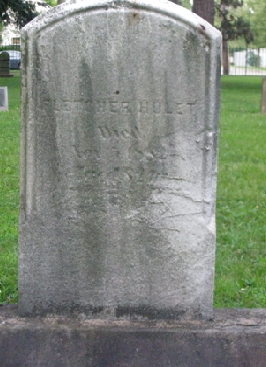
| Fletcher Hulet was born in Lee or Tyringham, Berkshire County, Mass. on April 6, 7 or 9, 1803. His family lived for a time in Killingsly, CT. His father, John Hulet Sr., was a veteran of the Revolutionary War. His mother, Hannah Walker Hulet, was John Sr.'s second wife (unsigned handwritten note, Hulet family file). His family was among the pioneers of the Western Reserve. Three brothers, Wesley, Isaac, and Abijah, came west in 1816 with a brother-in-law, Seymour Chapin [name given elsewhere as Samuel Chapman], and a sister, Sally Hulet [married name Curtis], to establish a homestead in Brunswick, Medina County, OH. Chapin built a log cabin for Sally and the others, and then returned to MA to bring out the rest of the family. Sally's obituary tells of her struggles as a woman in a tiny cabin with her brothers, encounters with Indians, etc. When the family arrived is unclear, but one version of the story suggests it was long enough for Sally to marry in 1818 and bear 8 children (Births, Marriages, and Deaths, entry for Sally Curtis, pp. 224-225). In another version of the story, Fletcher's daughter Harriet reported that at age 13 (ie, 1816) "he emigrated with his father's family to Brunswick, Medina Co., Ohio, passing through Cleveland when it boasted of three stores--all built of logs. He drove an ox team the whole distance and even space for roads was hardly cut through the magnificent forests which then covered the Western Reserve." She said that her father was "sometimes rough, sometimes cold, always distant" on the outside, but that underneath beat a "good, grand heart"; she attributed his manner to his hard upbringing, to "the unfortunate repressive habits of the times and family in which he was reared," and to the "uncompromising clothing of home manufacture, both of cloth and cut, which seemed some way to enter into, and become part of the angular uncompromising character of the race that grew up in that generation." John Hulet and his sons soon became known as excellent craftsmen and mechanics, always called upon to help framing houses or barns, building mills, setting up waterwheels, traveling from Akron to Marietta to Tallmadge. Fletcher too inherited the family gift for mechanics (Walker 1). His daughter believed that had he been given the opportunity for formal education, he would have proved gifted in astronomy, mathematics, or mechanics; she also says "his desire for an education filled his whole life, and without knowing it, he had it" (Walker 1). It was on a visit to the Tallmadge mill that Fletcher first encountered Methodism (according to a bicentennial biography of John Hulet Sr. in the Hulet family file, Fletcher's parents were Congregationalists). Young Fletcher passed by a camp meeting; at this time, there were few churches in the Western Reserve, and most people were not religious. Roving circuit preachers traveled hundreds of miles from place to place, holding meetings at which they exhorted the faithless to honor God, behave morally, and convert. These events could be quiet and decorous, or rowdy, with hundreds of people moaning, jumping, or passing out in fits of religious ecstacy (History of Methodism in Berea 13-20). Fletcher apparently listened to little less than half the sermon, which was on the duty of the nation and the Church, and men of means, to support education. But after he drove some ways away, he stopped his team of oxen, got down on his knees, and cried to God in repentance, vowing to devote himself to his own education and to the education of others (Walker 4). Fletcher met the love of his life, Miss Frances "Fanny" Granger of Pittsfield, MA, when she came to Brunswick to visit her sister, Mrs. Dr. Ezra Somers. By the time she left for home, she had already agreed to marry Fletcher, "the back-woods-miller-mechanic, who in his way looked up to her as something better than human" (Walker 2). He planned to go east to marry her, but worked so long into the fall that lake Erie was almost closed [by ice?] to travelers. And when he got to Berkshire, he realized that Massachusetts law required a couple to reside together for three weeks after public announcement of their joining, in order for the marriage to be legal. As he could not wait three weeks, lest they be trapped in MA all winter, he took his bride, and her sister and brother in law as witnesses, over the border to Scodack, NY, where no such law existed, and there they were married on 16 Nov 1829 (Walker 2). [According to genealogist Don Labaj, Fletcher married Fanny on 16 Dec 1829, in the Town of Schodack, (Rensselaer), New York.] Back home, on the couple's new homestead, Fletcher was consumed with a desire to learn, studying arithmetic, algebra, geometry, astronomy, mechanics, and history. His daughter claims that he memorized and never forgot anything he had learned. He also built with his own hands a red two-story farmhouse and all the internal woodwork, including delicate details such as a china closet over the mantle in the parlor (Walker 2). The couple had four boys and two girls, whose appearance ignited in Fletcher a burning desire for their education. The oldest child, Martha, was sent to a boarding school at three years of age, against her mother's wishes, but Martha came home after one week of homesickness and stayed home until the following year. Martha, Margaret, Clara, and Gilbert later went to the local district school, where they had six hours of lessons each weekday and three on Saturdays, and more when their father drilled and examined them at home (Walker 2-3). The whole family enjoyed music and singing as well (Walker 3). The Hulet family migrated from Brunswick to Berea in 1846 when the Baldwin Institute opened, attracted by the prospect of education for their girls as well as their boys, as were many Berea settlers of that time (notes on Fletcher Hulet and Hulet Hall, Hulet family file, Berea Historical Society). Fletcher's daughter reports that in 1845, when Fletcher heard that "Uncle John Baldwin" was building an Institute that was to be a "great educating Methodist center," Fletcher "scratched his head, shook his hat on a little tighter with one of his characteristic quick jerks of the head, walked out to the shop, sat down on the workbench, and began to whittle." After long thought, he shocked his family and church by announcing that he was going to move the whole family to Berea to "let the gals and boys go to Uncle Johnie's school" (Walker 3). In Berea, he built a two room shanty a stone's throw from the school [could it still be there, a small century home on S. Rocky River Rd. facing the park?] and Martha (16), Margaret (14), Clara (12), Gilbert (10), and a 22-yr old boarder, Sam Stebbins, were all sent to the Baldwin Institute (now Baldwin-Wallace College) on its very first day (Walker 3). Other sources confirm that Fletcher's daughters, Martha, Margaret, and Clara [Clarissa] were among the first Baldwin Institute class of 1846 and continued there into the 1850s, and Gilbert Mather Hulet joined them in 1851 (Baldwin Institute Catalogues, 1846-1867; Shaw 32). An Orra Jane Hulet also appears as a student in the 1840s and 50s, from York, OH; her relation to the rest of the family is unclear (BI Catalogues, 1846-1867). Fletcher's family remained associated with the school until the outbreak of the Civil War (Walker 3). His daughter Harriet would eventually become a professor in the Department of Fine Arts at Baldwin University, 1860-1863, teaching piano, melodian, and guitar (notes on Thomas B. Walker and Harriet G. Hulet in Hulet family file). Clara's husband Rev. John Wheeler became president of Baldwin University. Clara and her husband remained as professors at the college even after the war (Walker 3). Fletcher also played a part in the other pillar of Berea's development, the sandstone quarries. He owned one of the first commercial quarries in Berea, which would later become the grindstone capital of the world. His quarry was called "Hulet and Holmes" in the 1840s, then "Hulet, Holmes, & Co." (Sago 17, 19) and later simply "Fletcher Hulet" (Sago 16). His land had sandstone very near to the surface, so for 20 years he was able to quarry stones by hand-cutting it, lifting it into ox carts, and then hauling it to construction sites. Much Berea sandstone was of the best quality, especially the famous "Berea Ten Foot Sheet" that was grayish white in color, free of pebbles, fine grained, and 93% silica. When cured properly, it was impervious to water, salt, and chemicals. The best stone was used for grindstones, the second best for buildings, and the rest for paving blocks and flag stones (Sago 14, 17). The Hulet quarry provided mostly construction blocks in the 1940s (Sago 17). The Hulet quarry and gristmill were located opposite the end of West St. in what is now the Metroparks Mill Stream Reservation, on the east shore of Baldwin Lake. A photograph in the Hulet file of the Berea Historical Society shows the Hulet mill and rail tracks crossing the stream just below a semi-circular dam; the dam still crosses Baldwin Lake and a road now crosses the bridge where the rail tracks once were (Fletcher Hulet Gristmill photograph). The Grindstone City Advertiser noted Fletcher's quarrying business:"Fletcher Hulet has laid the foundation for a large stone building on the quarry railroad track, directly west of the University to be used as a warehouse" (24 April 1874). Fletcher's business was prosperous enough that he was able to exchange the shanty and the farm for a fashionable house in Berea town, which he equipped with the "first piano ever heard in Berea"--to the consternation of his thrifty neighbors (Walker 3). The Hulet family was enumerated in the 1850 census in Middleburgh Twp, neighbors to fellow pioneers Henry and Elizabeth Bevans and James and Julia Baker, on the fashionable south side of town. Fletcher Huolet [sic] gave his age as 47, born in MA, a farmer with $2000 real estate. Wife Fanny was also 47, from MA. Children were Martha (20), Margaret (18), Clara (15), Gilbert (14), Harriet (9), Marshall (4) and some Irish laborers: James Fitzgerald (22), Michael Carey (22) John Carey (20), and from Ohio, Henry Harkness (18). Harriet, Gilbert, Clara, and Margaret were all attending school. Fletcher also served as the third mayor of Berea in 1855 and 1956 (Shaw 6, Labaj CD). This picture of prosperity and vigor was marked by tragedy. The oldest son, Gilbert, died in 1854 of typhoid fever at age 18. A granddaughter born to daughter Martha and Charles Lyon, named Margaret C. Lyon, died in 1855 ("Inscriptions"). Martha had been crippled by disease for 6 1/2 years of her childhood, but a corrective surgery had freed her to marry. Her husband served under Custer in the Civil War, was partially paralyzed, and also died after a few years, leaving Martha to care for their remaining six children (Walker 4). Daughter Margaret died in 1856. She had married a southerner, Wm. H. Chappell, but the union was short: "she lived long enough to lay one baby boy in his grave, and then faded away." Her son's name was Rowland. Her husband returned to the south, and fought on the Confederate side in the Civil War (Walker 4). Clara and her husband John Wheeler had seven children, one of whom died in infancy of whooping cough [John Wheeler Jr] and the other ["Willie" or Mary Agnes? Wheeler] at age 13 when an iron wheel overturned in their own yard (Walker 4; "List of burials and names"). In fact, the only family member not struck by tragedy was Harriet, who married Thomas Walker, a fellow student at BU and civil engineer, and raised eight children in MN (Walker 5). In 1860, the Hulet family was enumerated in the census again, still in Middleburgh Twp: Fletcher Hulet gave his age as 56, his occupation as grindstone manufacturer, and his worth in real estate as $21,000. He had $3000 personal property and his birthplace appears as CT, where his family lived after his birth. Wife Fanny was 56, born in MA. Children were Harriet (19) and Marshall (13). Both were attending school. They were living next door to, or perhaps housing, married daughter Martha Lyon (29) [her husband Charles was not present], and her children James (4), Genville? (3), Grace (3), and Charles (9 mo), a Canadian laborer, Henry Grien (20), and a student from NY, William McDermott (17). The census records generally suggest a prosperous family with a commitment to education. Fletcher Hulet had been a Democrat while young, even teaching his children to read by spelling out the letters of the newspaper "Cleveland True Democrat." It was the issue of slavery that brought him into the Republican Party in the years before the Civil War. His daughter reports: "The celebrated Fugitive Slave Act wrought him to a white heat. The scene rests distinctly in the memory of the writer when he first read the text of the bill. He threw the paper on the table and walked the floor in uncontrollable agitation, shedding tears even in his grief and indignation, that such could have been made a law. 'We are every one as much as slaves,' he said, 'as though there were chains on our wrists. We are as much slaves as the blackest negro in the southern cotton fields. I am ready to fight, and will fight or go to jail before I will submit. And I tell you, Fanny, this settles in my mind what I have long felt, that the curse of slavery will never be wiped out till it is wiped out in blood!' He lived to see the prophecy literally fulfilled…His years were against him or he would have taken the field when [his son] Marshall enlisted; and when Morgan threatened Cleveland [in Morgan's Raid], he shouldered his gun and went to the front" (Walker 4). Son Marshall enlisted when he was four months shy of 16, serving in the 103d Ohio Volunteer Infantry along with Bereans Cassius Warner and David Pardee, served through the whole war, "marched with Sherman to the sea" and was discharged after General Lee surrendered. He returned to Berea and married 19-yr old Caroline "Carrie" Hunt, who died after only one year of marriage. Marshall, haunted by grief, spent the following years wandering the old battlefields of the south (Walker 5). In the midst of the nation's upheaval, Fletcher Hulet was at a meeting of the Baldwin University trustees, when they announced that they had no funds to build a college chapel. Fletcher stood up and told the story of his conversion and vow to support education, and pledged to build the chapel and pay half of its cost (Walker 4). And so he built Hulet Hall for Baldwin University with stone from his own quarry, working on it even at night. He finished the 90x56 ft building in 1868, and gave the college $16,000 (Hulet family file). Hulet Hall was used for chapel, classes, and for evening public lectures; one such was given by a traveling scholar in Feb 1876 for the "Phreno-Cosmian Society" on "Egypt, Past and Present" (Grindstone Advertiser, 3 Feb 1876). Fletcher was also active in real estate sales: for example, he made $600 on sale of a lot in the Baldwin additional area of Berea (Grindstone Advertiser, 28 Jan 1870). The Cuyahoga County Recorder's Office lists more than 50 deeds in his name. Fletcher was mentioned in the 14 August 1869 Grindstone City Advertiser: "Ordinance [Tax]……….On 4 14-100 acres Fraction E. 3 P.N of Cemetery owned by Fletcher Hulet, the sum of seventy-five 7-100 dollars to pay for cost and expence[sic] of laying a side walk in front of said land, on Adams street." Despite these successes, Fletcher's fortunes turned for the worse when he lost his wife, Fanny, in 1865. She was gentle natured, the consummate hostess, but suffered terribly from asthma, which eventually took her life. Her daughter wrote: "She had all unconsciously to herself or him, been the steady, even governor of his whole life which had made it a success. Of the sixteen years that followed her death, I have no heart to write. 'While Fanny lived,' he said to me, 'everything I touched turned to gold; but after she died everything turned to lead'" (Walker 5). Fletcher Hulet was enumerated in the 1870 census, still in Berea, age 68, a dealer in grindstones with real estate worth $40,000 and $2000 personal property--making him easily one of the richest men in town. He also had a new wife, Lois [Case], age 62, born in NY. There is no marriage license for Fletcher Hulet or Lois Case in Cuyahoga County. Of this marriage, Fletcher's daughter wrote: "He married again, it is true, but the marriage was not a happy one--as indeed I do not think any marriage could have been in the very nature of things. His home was broken up, his children scattered, his splendid property gone into the grasp of sharpers, his health impaired, his mind unbalanced by grief and loneliness, and so he dragged out the years. He tried to live with his children but could not stay away from the graves of his loved ones and the little place by their side that he had marked out for his own resting place" (Walker 5). To ensure that resting place, he donated some of his own land to the adjoining Adams St Cemetery. In April 1866, Fletcher Hulet sold to the Cemetery Trustees, for $136, a plot of land on the north side of the Adams St Cemetery .76 acres in size, reserving .08 acres of it for his family's burial plot. The configuration of the lot suggests that it includes current lots 147-212, and that the reserved portion is where the Hulet lot is now located (i.e., lots 193-194, unsold lots 191-192, and possibly lots 183-184 and others later sold to Frelk/Brown and thence to the Schneiders and Wylies): "commencing at the N.E. corner of Berea village Cemetery on Adams street, thence west on the north line of said Cemtery lot five chains and seven links to the north west corner of said Cemetery lot, thence north in a line with the west line of said Cemetery lot one chain and fifty links to a stake thence east parallel with the south line five chains and seven links, thence south one chains and fifty links to the place of beginning…deducting from the above…land commencing one (1) chain seven (7) links west from the first mentioned point above on the north line of said Cemetery lot, thence west on said line (90) links, thence north (89) links thence east parallel with the south line (90) links, thence south parallel with the west line (89) links to the place of beginning containing (.08) eight one hundredths of an acre of land…the above reserved piece of land is to be used only for burial purposes and to be under the control of the Council & directors of the Cemetery in regard to laying out lots and alleys &c the same as the rest of the Cemetery" (Fletcher Hulet deed, 3 Dec 1866). Perhaps Fanny, Gilbert, and the others had been buried on the Hulets' own land, as was common at the time, and he wanted to be assured that they rested within a protected space; perhaps he had them moved from other lots within the cemetery, but he does now rest by their side. Fletcher continued to operate a mill, as is evidenced by various newspaper articles. On 15 April 1870, the Grindstone Advertiser reported on improvements at his mill: "F. Hulet, Esq.. Is putting up at his stone shop, a new steam engine for turning grindstones and for other applications of power. The engine is inside, and the boiler and lathe outside the building. A very tall iron stack takes the place of a chimney." But increasingly it was his problems that became public news: on 14 April 1871, the Grindstone Advertiser reported: "Mr. Fletcher Hulet brought an action against Mr. William Couch to eject the said Couch from possession of certain premises to which the said Fletcher Hulet held the legal title. To the petition of Hulet, Couch answered, denying that he unlawfully kept Hulet out of possession and that he (Couch) had the right of possession. Also setting up the defense that on the ninth day of September 1866, Hulet sold to Couch by written contract the premises described in the petition, the conditions of said contract being that said Coach should pay said Hulet the sum of $500 for said premises: one hundred of which was to be paid down, and the balance in four equal annual payments; that about $200 had been paid and that Couch was ready and willing to pay the balance due. The petition was died sometime after the last payment became due. To the answer of the defendant the plaintiff demurred, and the case was argued upon the facts shown by the pledges. The Court held that in an action of ejectment against a party holding possession under a land contract, the conditions of which he had failed to perform, as in this case, the contract was no defense. Judgment was rendered to the plaintiff. Foster and Lamson for plaintiff; and Barber and Andres for defendant." Likewise, thefts: Grindstone Advertiser, 12 May 1871: "Mare Stolen. Mr. Fletcher Hulet had a mare stolen on the night of Wednesday the 10th. The thief must have taken the animal between 8 and 9 o'clock of that evening, as it was in the stable at eight and missed at nine. This following is a description of the beast: Age, 6 or 7 years; color, dark bay, with black mane, tail and legs; size, medium; weight, about eight hundred and fifty pounds; condition. High. Mr. Hulet hereby offers a liberal reward to any one who will recover the property, or apprehend the thief." And the Grindstone Advertiser reported on 25 March 1875: "Three men were tried before Mayor Brown yesterday for breaking into Fletcher Hulets mill and stealing belting and other articles but the evidence was not sufficient to hold them." The 8 August 1873 Grindstone City Advertiser mentions a burglury at the Hulet home: "Burglary.—On Thursday night of last week a burglar entered the residence of Mr. F Hulet on Main street, and secured about twenty-five dollars in money which had been left lying around loose in the sleeping apartment of Mr. Hulet. He then went up stairs where his movements awakened a lady—she screamed, and the man escaped. No clue to the thief." Fletcher Hulet died Nov. 5, 1882. His daughter noted "How gladly he lay down when his summons came. How sweet the spirit with which he met death at last: the monster, spite of his strong religious faith, he had all his life feared" (Walker 6). The following obituary appeared in the Nov 9 Berea Advertiser: "Death's Doings. A cloud of sadness rest over our little town this week. The relentless Reaper has been busier than usual within the past few days, and there are many sad hearts who refuse to be comforted. Fletcher Hulet. This well known citizen whose age and infirmities have borne heavily upon his feeble frame for several months, expired last Sabbath morning. He had been confined to his bed but a few days, and was affilicted with no particular disease, but there seemed to be a general giving way of the entire system. His last hours were cheered by the presence at his bedside of his daughter, Mrs. D. [sic] Wheeler, and other relatives. Mr. Hulet has been a citizen of Berea for thirty-six years. He was distinguished for his strict integritv[sic], industry and generosity. Hulet Hall, which bears his name, stands as a memorial of his liberality, he having donated about $16,000 toward its erection. He was a man of peculiar views, and for the past few years his mind has been somewhat unbalanced. But as the end of life approached the clouds seemed to disappear and his intellect again became clear. At one time he had considerable property, but through misfortune in business he became poor. He was somewhat distinguished among those who best knew him, for his mechanical genius, as wel as for his mathematical ability. Could he have had the necessary advantages of securing an education in youth he would undoubtedly have become proficient in mathematics. He had a remarkable insight into the relation of numbers; his mind seemed to run in that channel. He took a lively interest in the education of his children and in the educational institution of the place. The funeral occurred at the Stone church, Tuesday afternoon, and was attended by many who have known him through life. The services at the church were very impressive. The casket, borne by Messrs. Wm. Nokes, C. Aldrich, S.Squires, S.F. Stone, E. Savage, I. N. Thayer, A. Hunt and Rev. McKean, supported a sheaf of ripened grain. Dr. Kepler read an appropriate selection of Scripture, and Rev. B.J. Hoadley read a hymn, which was beautifully rendered by a choir consisting of Miss Fournier, Mrs. Cash, Miss Vansise, Mr. Lyon, Mr. Shaw and others. Miss Prof. Bigelow presided at the organ. Dr. Schuyler invoked the divine blessing, after which Dr. Peirce read a brief history of the life of the deceased, and spoke of the state of the blessed in Heaven. Appropriate remarks were also made by Dr. Schuyler and by Rev. A.J. Lyon. The remains were taken to Woodvale vault and eventually will be laid beside those of his first wife in the village cemetery. Obituary Fletcher Hulet, the subject of this sketch, was born in Tyringham, Berkshire Co., Mass., April 7th, 1803. With his father’s family he removed to Brunswick, Medina Co., Ohio, where he resided until 1846, when for the purpose of educating his children he removed to Berea, Ohio, where he spent the balance of his life and where he died at 12:45 a.m. Nov. 5th, 1882. At the time of his removal to Ohio the whole country was an unbroken wilderness and his early life was spent amid the hardships, privations and severe physical labor common to those days. His intense energy, and exceptionally perfect physical organization, together with his surroundings, fastened upon him the habit that remained with him through life, of extreme labor. It seemed as if he could not rest. Whatever his hand found to do, he did with his might, and this continually. As far back as his children can remember his only recreation seemed to be in mental labor, and mathematical and philosophical studies, as exhausting to most persons as the most severe mental labors. The long winter evenings often come vividly to the recollection of his children when he used to sit among them as they gathered about the old fireside and explain and help them to understand the lessons that he delighted to see them mastering in addition to the daily tasks at school. At the opening of Baldwin University, then Institute, in April 1846, he came to Berea and put up a small frame shanty, one of the first built on the south side, except three old buildings that had been standing many years. This served to accommodate his three eldest daughters whom he placed in school, and give him a home while he built a house for his family, which he immediately did. From that day on, his interests were identified with those of the University to which, as is well known, he gave without stint both of his labor and his means. Hulet Hall to which he gave $16,000 and labor uncounted, stands as a memorial of that interest. Himself an uneducated man he felt an intense desire to give to others the advantages that had been denied to him. He was twice married. In 1829 to Fanny Granger, with whom he lived for thirty-six years, and the memory of whose loveliness of character is a perpetual benediction to those who knew her, and by whose side he requested to be buried. In 1866 he was married the second time to Mrs. Lois Case, who survives him. His funeral occurred Nov 7th, twenty-eight years to a day from that of his eldest son Gilbert. His last week on earth was full of comfort and consolation. His mind was clear as at any time in his life for a good part of the time enabling him to give directions and explanations with reference to his business, and his funeral , and to enjoy and appreciate almost to the last hour of his life the reading of the Bible, making his own selections with rare discrimination. 'Full of years and full of honors his works do follow him'." On Dec 7, 1882, the Berea Advertiser reported "C.C. and J.T. Hulet have been appointed administrators of the estate of Fletcher Hulet deceased." Chauncey Hulet was Fletcher's nephew, son of his brother John Jr., and Jonathan Turner Hulet likely the son of another brother. Berea's records do not list a burial for Fletcher Hulet, but the records from that year are fragmentary. Fletcher's tombstone was transcribed in 1904 as saying "Fletcher Hulet, d. Nov. 5, 1882, ae 82 yrs" and in 1934 as "Fletcher Hulet, died Nov 1882, age 82 yrs." In 2007, the white marble marker was found to be gray with dirt and worn, but the name still legible. He rests in a family plot with Fanny, his 1st wife, his children Gilbert and Margaret E. Chappel, his nephew J. T. Hulet, J.T.'s wife Mary E. Foster Hulet, his grandchildren Rowland Chappel and Margaret C. Lyon, and grand nephew Wesley Edwin Hulet; nearby in lot 184 is the grave of son-in-law Charles Lyon and two unmarked graves that may hold other relatives, possibly including Fletcher's mother, Hannah Hulet. Most of the markers were cemented to two linear sandstone bases during the 1930s, some were cemented facing the wrong way, and breaks were repaired badly, obscuring inscriptions. Hulet Hall was taken down and rebuilt north of Bagley Rd. in 1898, with the rest of the old Baldwin University campus, after the Cleveland Stone Co. bought the land underneath the old campus (Sago 12, 17). The rebuilt building was completed in 1902 and used as a dormitory, much beloved by students ("Hulet Hall 1902-1972"). In 1972, the deteriorating building was torn down because renovations were judged too expensive (this was a time of financial hardship for the college); its place was taken by a parking lot east of Ritter Library (Hulet Hall, Ritter Library construction photographs, Baldwin-Wallace College Office of College Relations). If you pass his grave, remember this. As he lay dying, he whispered to his daughter "Put on my tombstone, 'saved by grace'…" To this she responded: "We, who have known and seen and understood, say, 'Write, 'made Perfect through Suffering'" (Walker 6). The Baldwin-Wallace College Historian's House file for Fletcher Hulet contains a program from a past Founders Day: "Program for the Founders Day event from 1968: Held at Lindsay Crossman Chapel FOUNDERS’ DAY Blurb about John Baldwin FLETCHER HULET, Benefactor PRAYER TRIBUTE TO FLETCHER HULET Mr. Richard Brenner LAYING OF WREATH OF TRIBUTE Dr. A.B. Bonds, Jr. Mr. Richard Brenner BENEDICTION (INSERT FROM THE PROGRAM) FLETCHER HULET Fletcher Hulet was born in Lee, Massachusetts, April 3, 1803. In his thirteenth year he emigrated with his father’s family to Brunswick, Ohio. The Hulets were born mechanics and Fletcher inherited mechanical and inventive bent of mind, and if he had the advantages might have made a brilliant record in astronomy, mathematics, and mechanical inventions. His desire for an education filled his whole life. Married in 1829 to Fanny Granger, they resided at his farm in Brunswick. A few years later when word went out over northern Ohio that John Baldwin was establishing a great Methodist educating center, Fletcher brought his family to Berea, where they were identified with the school from the first term. Soon after settling in Berea, he became a quarry owner, and with the assistance of student help erected and donated to Baldwin University its largest building, known as Hulet Hall, a stone structure, the first floor of which contained recitation rooms and the upper the auditorium for chapel services, commencement day exercises and lectures. When the old campus was sold to the Cleveland Stone Company, it was taken down and rebuilt with the same blocks on the present campus and still bears its original name, Hulet Hall." A letter from Fletcher's daughter Clara Wheeler also appears in the file: Aug 13/28 My Dear Frances It is so long since I have written you or heard from you! Not- indeed because I have not wished to write, but because of a seeming disagreement of hand and pen, which for several months kept me from working, though my general health was good. Now however they seem to be on better terms and are once more doing fairly good tearm[sic?] work. But my friends are very good to me remembering that I am in my 94th year, overlook my shortcomings & write me often. SO I get letters from Mass, New Hampshire, Cal- Washington DC, Ohio, Michigan. Fletcher Hulet's tombstone was a tablet on a base. It was 30 1/4 inches high, 18 1/4 inches wide, 4 inches thick. It is in sound condition, was eroded, and had moss and lichens on it. It was also weathered. There was a previous repair with cement. The tombstone was inscribed. In 2009, the tombstone had been cleaned of natural material with D-2 and water. He was born on April 7, 1803 and died on November 5, 1882 at 82 years old. He died from old age and general infirmity. |
sources |
| Hazel E. Foster, "The Bi-Centenary of a Western Reserve Pioneer, John Hulet, Sr." Hulet family file, Berea Historical Society "Another Pioneer Gone," obituary for Sally [Hulet] Curtis in the Republican Advertiser; in Births, Marriages, and Deaths: Reported in newspapers published at Berea, Cuyahoga County, Ohio, November 1868-January 1879, Strongsville, OH: Southwest Cuyahoga Chapter-Ohio Genealogical Society, 2001, pp. 224-225; Berea Historical Society. Harriet Hulet Walker, "Fletcher Hulet," biography written for Hulet family reunion, published iin unidentified journal, 29 July 1887; citing incomplete copy in Hulet family file, Berea Historical Society; another incomplete and oddly chopped-up copy is in A. R. Webber, pp. 178-188. A. R. Webber, Biography of John Baldwin, n.p.: Caxton Press, 1925 Catalogues of the Institute and Baldwin University, 1846-1867, bound copy, Baldwin Wallace Historian's House A History of Methodism in Berea, 1843-1976. Berea, Ohio: privately printed, 1976. Mickey Sago, Then There Was None: A History of the Berea Sandstone Quarries. Berea: Berea Area Historical Society, 1996. Willard H. Shaw, A Collection of Historical Facts on Berea, Ohio. Centennial,1836-1936. Souvenir edition. Berea, OH: Mohler Printing Co., 1936. Unsigned notes on Fletcher Hulet and Chauncey Hulet, Thomas B. Walker and Harriet G. Hulet Walker, Hulet family file, Berea Historical Society. "Hulet Hall 1902-1972," The Exponent [BW student newspaper], vol. 59, no. 22, 5 January 1973; also in Hulet family file, Berea Historical Society "Number of Burial lots and prices," Adams Street Cemetery folder, Berea Historical Society. 1850 US Federal Census, Fletcher Huolet household, Series: M432 Roll: 673 Page: 183 1860 US Federal Census, Flelches Muelett household, Martha Lyon household, Series: M653 Roll: 954 Page: 122 1870 US Federal Census, Fletcher Hulet household, Series: M593 Roll: 1193 Page: 429 1880 US Federal Census (not confirmed) www.Rootsweb.com Don Labaj, Berea Families CD, 2006 Fletcher Hulet Gristmill photograph, Hulet family file, Berea Historical Society Fletcher Hulet deeds, Cuyahoga County Recorder's Office online. Various notices on Fletcher Hulet and advertisements, Grindstone Advertiser, 1870-1875. Fletcher Hulet death notice and obituary, Berea Advertiser, 7 Nov 1882 and 9 Nov 1882. E. S. Loomis and D. T. Gould, "Inscriptions from the Old Berea Cemetery," 1904, Berea Historical Society The Berea Enterprise, 24 June 1932, p.1 c.1-2, p.6 c.5-6 "Cuyahoga Cemetery Inscriptions," Vol. I, compiled by the Western Reserve Historical Society, 1934 Fletcher Hulet tombstone photograph, Jeremy Feador, 2006. Grindstone City Advertiser,14 August 1869 GCA, 8 August 1873 GCA, 24 April 1874 GCA, 26 August 1875 GCA, 27 September 1877 GCA, 20 December 1877 GA, 24 January 1878 Berea Advertiser, 4 November 1880 Berea Advertiser, 2 December 1880 Berea Advertiser, 2 November 1882 Berea Advertiser, 7 December 1882 1968 Founders Day Pamphlet, Fletcher Hulet File, Baldwin-Wallace College Historian's House Clara Hulet Wheeler, Fletcher Hulet File, Baldwin-Wallace College Historian's House Sample Survey Sheet for Individual Burial Markers, Fletcher Hulet, J. Orlando, 22 July 2009. |