
individual record


id | first | middle | last | dob | dod | cod |
| 30 | Silas | Clapp | 7/9/1802 | 10/24/1864 | Consumption |
veteran | exhumed | purchaser | cemetery |
| Adams Street |
lot | plot | ||||||
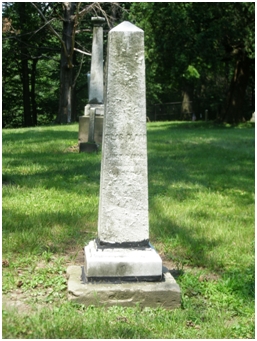
| R11 G1, south face bears name and full dates of birth and death. North face says "FATHER" |
relations |
| Esther Risley Clapp (wife, b. c 1810) George S. or Silas George (son, b. c 1834, attorney at law--same George S. Clapp as father of Berdie Clapp?) Jane Maria (daughter, b. c Aug 1837) Esther Ann "Hattie" (daughter, b. c Oct 1839) Andrew F. (son, b. c 1842) Emma Clapp(daughter, b. c Sep 1846) |
comments |
| The 1904 Inscriptionf from the Old Berea Cemetery state, "Clapp, Silas, b. Sheffield, Ct., July 9, 1802, d. Berea, O., Oct 24, 1864." The Cuyahoga County Cemetery Inscriptions state, "Silas Clapp, born in G---(illegible) July 9, 1802, died in Berea Oct 21, 1861." "Silas was born in Sheffield, Conneticut. He was one of the earliest settlers of Middleburg Twp. and may have come here to take advantage of the Connecticut Western Reserve. He was enumerated in the 1850 census in Middleburg, age 48, a miller with real estate valued at $2,000. His wife Esther was 40, his children were George (15), Jane (13), Esther A. (11), Andrew (7), and Emily (4). Also in his household was Julia Harmanson, age 55, from Conn., possibly his mother-in-law. All the children were in school. Later, Esther A., Andrew, and Emma all attended school (census). Silas George Clapp, Esther Ann Clapp, and Jane Maria Clapp all appeared in the Baldwin Institute Catalogue for 1850-51. The same catalogue also contained this statement: "There is no store, grocery, or tavern in Berea in which spiritous liquors are sold; and the usual haunts of vice, and the temptations to dissippation, common in cities and larger towns, are unknown" (1850-51 BI Catalogue, p. 25). Esther Clapp, Silas G. Clapp, and Jane Clapp were all among the first graduating class of Baldwin Institute--many of the early pioneers came to Berea because of the educational opportunities it afforded their children (Shaw 32) Silas Clapp owned a saw mill known as the red mill. The business had been owned by Richard Vaughn, one of the first twenty families to settle Berea (then Middleburg Township), but was moved across the river to the Clapp's mill. A description of Vaughn's mill says: "It was done in this wise; a wheel was put on the lower end of an upright shaft and on the upper end a crank was put in, which was about as high as the mill floor. The crank swung a pitman to the right and left which succeeded very well in moving a small gang of saws which furnished a large amount of stone for whetting scythes and shoe-knives." Clapp's partner's name was Amsbury. His mill was bought by F. M. Stearns (Shaw 14-15). Silas also became Mayor of Berea in 1863 (Shaw 6) After Silas's death, his widow Esther ran a boarding house, with Jane M. at school (age 32), Hattie A. at home (age 30), and Emma C. teaching music at home (age 24) (1870 census). She had 12 boarders, mostly students, including Ernest Leasman (Leesman), a civil war vet and minister once buried at Adams St (see entry 340). In 1880, at age 70, Esther was living with daughter Esther M (age 34). "Death of Mrs. Clapp From the Oberlin News. CLAPP-At her home 51 West College street, October 1, 1891, Esther Clapp, in her eighty-second year. She was born November 28, 1809. Her birth place was Silver Lake, in East Hartford, Conn. She was one of ten children of Timothy and Abigail G. Risley, only one of whom, the youngest brother, survives. She was converted in July and on the October following, 1825, she was baptized and received into membership in the Methodist Episcopal Church, and in its communion remained a steadfast and earnest member during a long and useful life and passed away in full assurance of faith. On Easter Sunday 1833, she was married to Silas Clapp, in East Hartford, whose trusting and helpful wife she remained until his death in Berea in October 1864. At the time of their marriage, “New Connecticut”—in other words the Western Reserve, was attracting the attention of the people of Connecticut, more especially. In 1834 she with her husband removed to a farm in Columbia, in Lorain county, and Ohio became thereafter their adopted state. Transplanted from cultured society in New England into the wilderness, she threw into the labors and work of the pioneer women of those times the natural earnestness and resolute energy of her character with never a touch of uncouthness or abatement of her nature, charming dignity and courtesy in manner and speech. Her husband was a licensed exhorter and an acceptable and efficient worker in the broad schemes and aggressive pioneer work of the church in those robust times, and she was his devoted and worthy companion in all good work. Their house was always the circuit riders refuge and home when he minded. Her piety, was deep but unostentatious, and unobtrusive. The practical side of it was especially emphasized and illustrated in her labors with the sick, suffering and dying. For more than a quarter of a century, after her removal to the wilderness of the Reserve she ungrudgingly and unselfishly gave her services both by night as well as day, when asked among the sick and suffering. In 1846, the family removed to Berea, Ohio, to take advantage of the educational facilities promised in the opening of “Baldwin Institute” under the superintendence of Rev. Holden Dwight. There she lived through the stirring times of the Mexican war ,and the fierce excitements which succeeded, and finally of the war of the rebellion. To such a great soul as hers, they were of intense interest, nor until within a month of her decease did she cease her interest in prominent questions of the day. Rev. W.C. Peirce, D.D., of Berea, and old and esteemed friend since 1846, conducted the religious services at her funeral on Oct. 3d, at which were present all of her five children. So has passed a great and good woman who took large and useful part in the early and stirring pioneer times of this Western Reserve, and who living to a ripe old age saw it changed from the wilderness to a rich and fertile land. She did her work grandly and has gone to her reward" (Berea Advertiser, 16 October 1891). Silas Clapp had a monument and obelisk type grave marker. The marker's orientation is North. The condition of it was sound, but lying on the ground. The severity of its condition was a 3 (1 being the least and 5 being the most). This severity was caused by settling. In the past there was a repair using cement and mortar. The grave marker was cleaned, as well as the mortar and cement being removed. D-2 and water was used for these repairs. Epoxy should be used once the weather is warmer. Silas Clapp was born on July 9, 1802 and died on October 24, 1864 when he was 62. He was a father. Silas Clapp had a granite marker. The lot number was 111, the row number was 11, and the grave number was 1. There was a fizz test completed with vinegar and there was no magnifier used to examine the grain. It is 3 feet high, 7 inches wide, and the thickness in N/A. The marker is facing Southeast. The inscription is facing South. This marker only commemorates Silas. The marker is not very decorative and the stone was very worn, it is the shape of a monument. The marker is chipped and the face is spalling or was delaminated. It is also dirty and has mold or green material growing on it. The inscription is mostly illegible. The inscription was incised. The marker states, “Silas Father” and the rest is illegible. "Clapp, Silas, prop'r grist mill." |
sources |
| E. S. Loomis and D. T. Gould, "Inscriptions from the Old Berea Cemetery," 1904; Adams St Cemetery folder Berea Historical Society "List of Burials and Names 1856-1871," City of Berea Records "Cuyahoga Cemetery Inscriptions," Vol. I, Western Reserve Historical Society, 1934 1850 US Federal Census, series M432, roll 673, p. 182. 1860 US Federal Census, Silas Clapp household, Series: M653 Roll: 954 Page: 124 1870 US Federal Census, Esther Clapp household, series M593, roll 1192, p. 427. 1880 US Federal Census, Esther Clapp household, series T9, roll 1009, p. 235. Willard H. Shaw, A Collection of Historical Facts on Berea, Ohio. Centennial,1836-1936. Souvenir edition. Berea, OH: Mohler Printing Co., 1836. "Numbers of burial lots and price," Adams St Cemetery folder, Berea Historical Society Catalogues of the Institute and Baldwin University, 1846-1867, bound copy, Baldwin Wallace Historian's House Berea Advertiser, 16 October 1891 Silias Clapp tombstone photograph, Jeremy Feador, 2007. Sample Survey Sheet for Individual Burial Markers, Silas Clap, S. Swinehart, 5 December 2009. Baldwin Wallace College History Dept. Cemetery Documentation Project, Silas Clapp, Kyrell Crook, 12 September 2007. Western Reserve Historical Society, Hawes Ohio State Gazetteer 1860-1861, Business Directory, Silas Clapp. |